
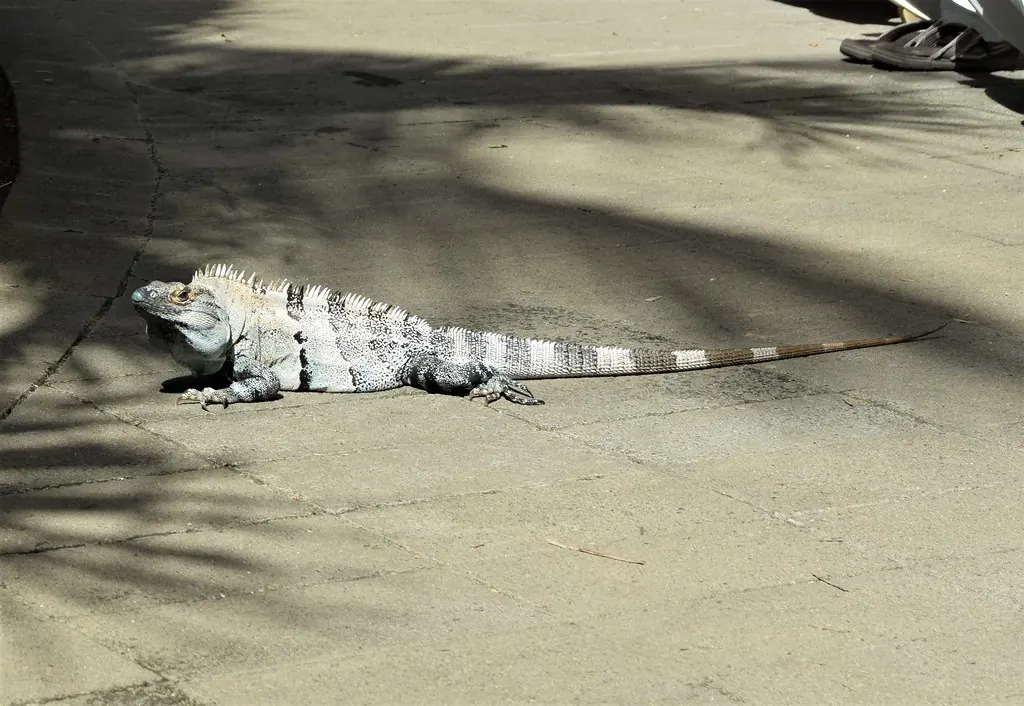
Iguanas in Tamarindo are part of everyday life: one suns itself on the hotel wall at breakfast, another crosses the garden path, and on the estuary tour our guides point out more resting on branches over the channel. What many visitors do not realize is that these are two different species, with different looks, habits and diets.
This guide helps you tell them apart, explains how they live and where to see them, and shares a few simple rules for watching them respectfully.
Short answer: the two iguanas you will see in Tamarindo are the green iguana (iguana verde), a large, mostly plant-eating lizard that lives in trees near water and has a big round scale below the ear, and the spiny-tailed iguana (garrobo, often called the black iguana), a grayish-black lizard with rings of spines on the tail that lives on the ground, rocks and walls. Green iguanas are best seen on an estuary tour; spiny-tailed iguanas are everywhere in town. Never feed or touch either one.
The green iguana (iguana verde)
The green iguana is the larger and more famous of the two. Big adults can measure around 1.5 meters (5 feet) or more from nose to tail tip, although most of that length is tail. In Costa Rica it is also called gallina de palo, a nickname that dates from the times when its meat was commonly eaten in the countryside.
- Color: young iguanas are bright green. Adults are often greenish-gray or brown, and adult males can turn orange during the breeding season.
- Key mark: a large, round, shiny scale on the side of the head, below the ear.
- Other features: a large hanging dewlap under the chin, a crest of soft spines along the back and a long tail with dark bands, but without spiny rings.
- Diet: mostly leaves, flowers and fruit.
- Habitat: trees near water, such as the mangrove and the riverbanks of the estuary.
Green iguanas are excellent swimmers. When they feel threatened, they often drop from a branch straight into the water and swim away with strong strokes of the tail. In the morning they climb to sunny spots in the treetops to warm up, which is when you are most likely to see them from the boat.
The spiny-tailed iguana (garrobo)
The spiny-tailed iguana is the one you meet at breakfast. It is very common in the dry lowlands of Guanacaste and has adapted well to life around people, using walls, roofs, rock piles and gardens as basking spots.
- Color: grayish, tan or blackish, with dark bands across the body. Surprisingly, the hatchlings are bright green, which often confuses visitors.
- Key mark: rings of sharp, spiny scales around the tail, which give it its name.
- Other features: no large round scale below the ear, a smaller dewlap and a row of spines along the back that is taller on large males.
- Diet: omnivorous. It eats leaves, flowers and fruit, but also insects, small animals and eggs.
- Habitat: the ground, rocks, walls and trees in dry, open areas. It shelters in burrows and crevices.
The spiny-tailed iguana is a very fast runner and one of the quickest lizards in the region. If you approach too fast, it usually disappears into a hole in a split second.
Green iguana vs spiny-tailed iguana: how to tell them apart
- Look at the tail. Rings of spines mean garrobo; a smooth banded tail means green iguana.
- Look below the ear. A big round scale means green iguana.
- Look at where it is. On a branch over the water, probably a green iguana; on a wall, a rock or the ground, probably a garrobo.
- Do not trust color alone. Old green iguanas can look gray or orange, and young garrobos are green.
Behavior worth watching
- Head bobbing: both species bob their heads up and down to mark territory or to signal to other iguanas. Males do it most.
- Basking: as cold-blooded reptiles, they need the sun to warm up before they become active, so mornings are a good time to see them still and exposed.
- Dewlap display: extending the flap of skin under the chin is another signal, often aimed at rivals.
- Tail loss: an iguana can lose part of its tail to escape a predator. The tail grows back, but usually shorter and with a different color.
- Nesting: females dig tunnels in sandy soil to lay their eggs during the dry season, and the young usually hatch around the start of the rains.
Where to see iguanas in Tamarindo
- Around town: spiny-tailed iguanas are common on hotel walls, gardens, rocky spots near the beach and empty lots. You do not need a tour to see them.
- The Tamarindo estuary: green iguanas rest on mangrove branches above the channels. They blend in with the leaves, so even sharp-eyed visitors miss them until the guide points one out. Look up into the canopy, especially on morning tides.
- The dry forest: on the short forest walk included in the estuary tours, garrobos often sit on trunks and fallen logs. Learn more about this habitat in our guide to the tropical dry forest of Guanacaste.
Estuary tours for green iguanas
- Tamarindo boat tour: shared, $40 per person, 2 hours, minimum 2 people, with a bilingual guide.
- Tamarindo kayak tour: shared, $60 per person, 2 to 2.5 hours, minimum 2 people, quieter and closer to the branches.
Both leave with the high tide, so the departure time changes every day and we confirm it by WhatsApp after you book. For the other animals on the same outing, see our guide to the wildlife tour in Tamarindo.
Please do not feed the iguanas
It is tempting to toss a piece of fruit or bread to an iguana by the pool, but feeding wildlife is not allowed in Costa Rica, and for good reasons:
- Human food, such as bread, fries or sweets, is bad for their health.
- Fed iguanas lose their natural fear and start approaching tables and people, which can lead to bites and scratches.
- Iguanas that depend on handouts change their natural behavior and can become a problem for hotels and neighbors.
Also avoid touching or picking them up. Besides the risk of a bite or a tail lash, reptiles can carry bacteria such as salmonella. If children are with you, iguanas are a great first lesson in watching wildlife from a distance; more family ideas in things to do in Tamarindo with kids.
Tips for photographing iguanas
- Approach slowly and stop often; quick movements send them running.
- Get down to their eye level for more natural portraits.
- Focus on the eye, and use the zoom for iguanas high in the mangrove.
Our guide to Tamarindo wildlife photography has more tips for the estuary.
Want to see green iguanas in the mangrove, along with crocodiles, herons and howler monkeys? Book the Tamarindo estuary tour by boat or the kayak mangrove tour with Tamarindo Estuary Tours Mi Rey online with a $15 deposit per person, or write to us on WhatsApp if you have questions about your date.
Book these tours
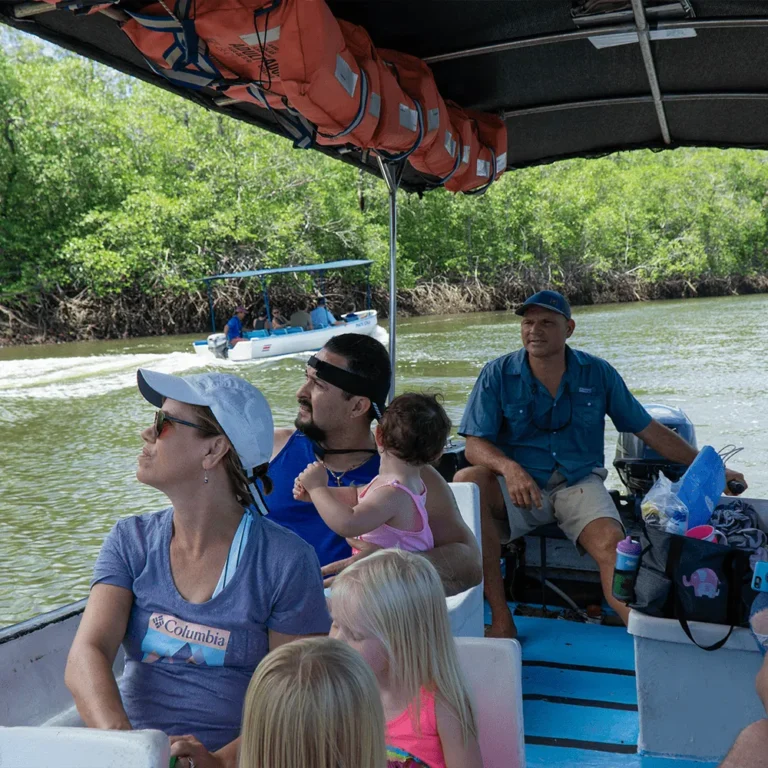 Shared Boat Tour (Mangrove Safari)$40 per personSee tour and book →
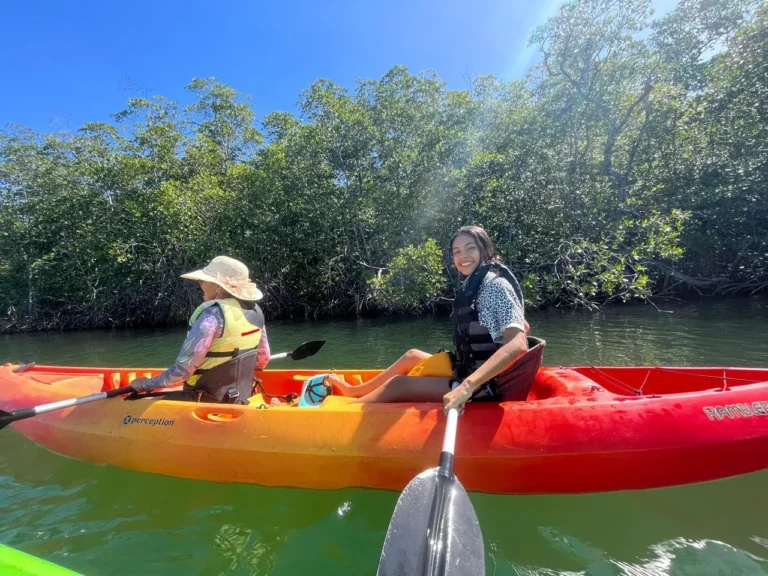 Shared Kayak Tour$60 per personSee tour and book →
Frequently asked questions
Are iguanas in Tamarindo dangerous?
No, as long as you leave them alone. Iguanas avoid people, but if they are grabbed or cornered they can bite, scratch or lash with the tail, so watch them from a distance and never try to pick one up.
What is the black iguana in Costa Rica?
Black iguana is a common English name for the spiny-tailed iguana, called garrobo in Costa Rica. It is grayish to blackish with dark bands and has rings of sharp spines on the tail.
Can I feed the iguanas at my hotel?
No. Feeding wildlife is not allowed in Costa Rica. Human food is bad for iguanas and teaches them to approach people and restaurant tables, which can end in bites.
Why are some green iguanas orange?
Adult male green iguanas often turn orange during the breeding season, which in Guanacaste falls in the dry months. Older iguanas can also look gray or brown rather than bright green.
Where is the best place to see iguanas in Tamarindo?
Spiny-tailed iguanas are easy to spot around town, on walls, rocks and hotel gardens. For green iguanas resting on branches over the water, the estuary tours by boat or kayak are the best option.
More Tamarindo guides
 Estuary, mangroves and wildlifeTamarindo Estuary: Crocodiles, Tides and What to BringPlan your Tamarindo estuary tour: crocodiles, herons and howler monkeys in Las Baulas, why the tide sets the time, what to bring, and boat or kayak prices.
 Estuary, mangroves and wildlifeNature Tours in Tamarindo: Estuary, Turtles, Forest and WaterfallsNature tours in Tamarindo: estuary boat and kayak tours, turtle nesting and releases, sloths, waterfalls and volcanoes, with prices, durations and seasons.
 Estuary, mangroves and wildlifeBoat or Kayak? How to Choose Your Mangrove Tour in TamarindoTamarindo kayak tour or boat tour? Compare shared and private options by effort, wildlife, kids rules, tides and price, from $40 per person.
 Estuary, mangroves and wildlifeCrocodile Tour in Tamarindo: Where and How to See Wild CrocodilesCrocodile tour in Tamarindo: where to see wild American crocodiles, how they behave, safety rules, the best tide and photo tips. Boat tours from $40.
 Estuary, mangroves and wildlifeAmerican Crocodile Facts: Meet the Crocodile of the Tamarindo EstuaryAmerican crocodile facts: how big it gets, what it eats, how it lives in salt water, how to tell it from a caiman and where to see one near Tamarindo.
 Estuary, mangroves and wildlifeTamarindo Mangrove Tour: Why the Mangrove Forest MattersTamarindo mangrove tour guide: the types of mangroves, why they are a nursery for fish and wildlife, and how to explore them by boat or kayak from $40.